

Integrating AI Watermark Removal Into Existing Content Pipelines
October 13, 2026
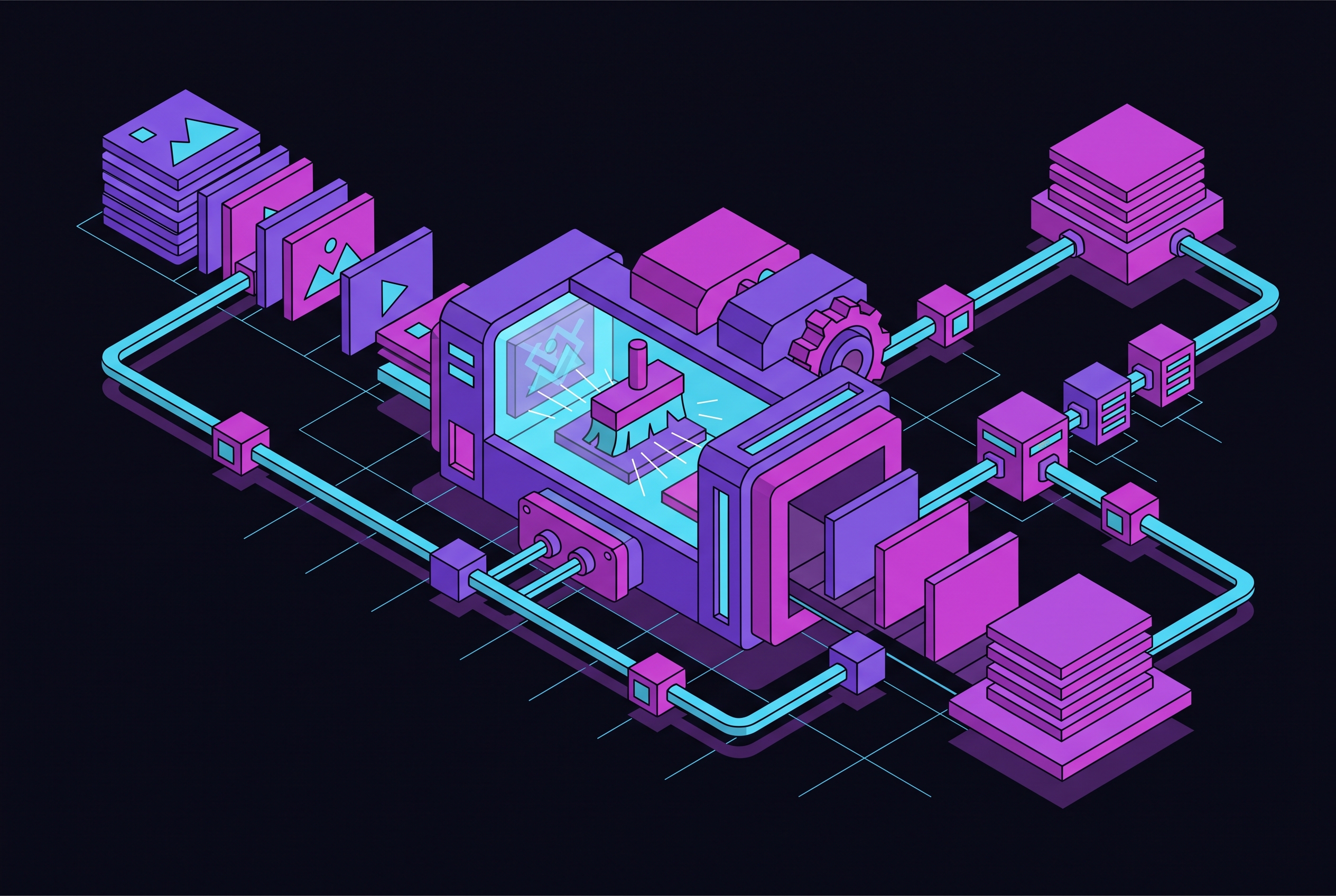
Integrating watermark removal into a content pipeline is a decision about where generation happens, not how editing happens. The right fix disperses authorship across multiple models at the moment of generation, so the single detectable signature never forms, and the rest of the pipeline stays exactly as it was built.
KGW watermark embedding in every token a single model generates
KGW watermarking works by splitting a model's vocabulary into two groups at each token position: a green list and a red list, assigned by hashing the tokens that came before. During generation, the model gets a small nudge toward the green list at every step. That nudge is added while the text is being produced, not afterward, as part of how the words got chosen in the first place, so there is no later stage in a typical workflow where someone could reach in and strip it out.
The signal gets stronger the more a single model writes. LIDet, presented at ICLR 2025, found that this signature survives even when a second model is fine-tuned on the first model's watermarked output. The signal does not stay contained to the model that produced it. It travels into whatever gets trained on that output next.
The detection statistic itself, the z-score, is built to accumulate evidence across an entire sequence: z equals the green-token count minus gamma times the total token count, divided by the square root of total tokens times gamma times one minus gamma. Long-form content, the kind most content pipelines are built to produce at scale, is exactly the case where this exposure is worst. The root of the problem sits at the point where tokens get generated, not at any point downstream where a human or a tool might later try to clean the draft up.
Paraphrasing and post-hoc rewriting cannot remove a structural signal
The obvious instinct, once a team understands that watermarking happens at generation, is to try to edit it away afterward. That instinct runs into a wall: rewriting either leaves enough of the original green-token bias intact to stay detectable, or it overwrites that bias with a new, different statistical pattern that a detector can still pick out as artificial.
The strongest current attack against KGW-style watermarking is BIRA, a method that applies a negative logit bias to a proxy set of tokens identified through their self-information, pulling green-token overrepresentation back down without needing access to the original model. BIRA reports evasion rates above 99% across a range of watermarking schemes and keeps meaning intact better than earlier approaches. Swapping a few synonyms around does not approximate what BIRA does.
A separate study out of Tsinghua on watermark removal found that targeted paraphrasing and what the researchers call inference-time watermark neutralization can fully strip an inherited watermark. Both methods depend on first knowing the rules the watermark follows, which requires a watermark-stealing step built on analyzing watermark radioactivity. That step does not need access to the original watermarking scheme or its hyperparameters, but it is still a real technical undertaking layered on top of generation, not a quick post-processing script.
Removal trades real cost for what it fixes. For a content team, that means a rewriting-based removal step adds a second capable model, adds latency, adds real engineering complexity, and still offers no guarantee of a clean z-score at the end of it. These attacks work under research conditions with full control over parameters and compute. A production pipeline running on a deadline and a budget does not get those conditions for free.
The z-score threshold for detection
A z-score is the one real unit of measurement for whether a watermark is present. Any claim that a tool successfully removes a watermark has to be checked against a stated threshold, not against how natural the output sounds to a reader.
The convention in KGW-family detectors treats a z-score above 4 as the operational definition of "watermarked," and a score below 4 as the operational definition of "undetectable by that particular scheme." A recent academic paper on watermarking tested KGW alongside several newer schemes across detection accuracy, how well meaning is preserved, and how the schemes hold up against eight separate attacks. Its results show detection accuracy sitting near-perfect for KGW-family schemes under normal conditions, which confirms that the threshold does its job reliably when nothing unusual is being done to the text.
Lettershred's own published benchmark gives a concrete picture of what passing that threshold looks like in practice: output z-scores dropped from 15.46 to -0.32 through cross-provider, multi-model dispersal, with most tokens rewritten across the process, landing well under the detection threshold of 4. A named number, measured against a named detector, on a known token count, is what counts as evidence here, rather than a general assurance that the output "reads fine. A human reviewer approving a draft is not evidence of anything about its z-score. Text can pass every editorial check a team runs and still carry a z-score well above 4.
Research on token-specific watermarking out of UC San Diego, presented at ICML, adds a further wrinkle: schemes that try to preserve meaning often do it by pushing the watermark signal into high-entropy positions in the text, the spots where word choice is least predictable. Those same positions happen to be the ones most exposed to targeted, token-level attacks. Detection strength and output quality move together rather than independently, so a scheme tuned to protect meaning is not automatically a scheme that is harder to evade; the two properties have to be evaluated side by side.
The architectural problem of a single model's signature
The fingerprint a single model leaves behind is a direct consequence of generating tokens from one model under one watermarking scheme. KGW's green-list assignment follows deterministically from a model's hash key and the tokens that came before it, so every token that model produces under that scheme follows the same bias. Across a long document, that bias accumulates.
The fine-tuning result from LIDet reinforces how deep this runs: training a second model on a single model's watermarked output does not wash the signature away. It carries the signature forward. The source of the problem sits upstream of any particular generation step, in the fact that one model, under one scheme, produced the whole thing.
Spreading generation across providers that use different hash keys and different green-list assignments breaks this compounding directly. If no single model contributes enough of the total token count for its own bias to push the z-score past the detection threshold, the score for any individual scheme stays below 4 as a matter of construction, not luck. That is compliance built in from the start rather than correction applied after the fact: the detectable signature stays below a removable level because it never fully forms.
What actually matters for anyone building or buying into a content pipeline is how many models contribute tokens during generation itself, and whether those models span providers with genuinely different watermarking implementations underneath them.
Fitting a multi-model generation architecture into an existing pipeline
A multi-model generation layer sits inside the generation step of a pipeline, and nothing else in the pipeline needs to move. Brief creation stays the same. Approval workflows stay the same. Brand guidelines, style guides, and publishing systems all stay the same. What changes is what happens between the moment a brief goes in and the moment a draft comes out.
In a conventional setup, one model takes the brief and writes the whole draft. In a dispersed setup, several model kernels draft in parallel from the same brief, and a selection pass, run line by line, assembles the strongest tokens or segments into one finished piece. The criteria for that selection pass can be whatever the team already cares about: fidelity to the brief, quality of the writing, consistency with brand voice. A multi-model origin does not force the output to read like something stitched together by committee.
Voice consistency has to be treated as a requirement of the architecture, not a hopeful assumption. An enhance pass that unifies tone and register across the assembled draft needs to be built into the pipeline as its own stage, with its own standard to meet, rather than left as something the final read-through is supposed to catch.
The latency math also works differently than it does for post-hoc rewriting. Lettershred's architecture is a working example of the pattern: a brief goes in, kernels across multiple providers draft in parallel, a judge selection process works through the draft line by line, and a final enhance pass produces a single unified voice, with a benchmarked z-score well under the detection threshold. The surrounding workflow barely notices the change, because the interface into and out of the generation step never moved.
Watermark radioactivity for teams using orchestration layers or API routing
Dispersing generation across models only works if a team can actually confirm which model produced which tokens. A pipeline that cannot verify that is not really guaranteeing dispersal at all, and two specific risks can undermine the assumption quietly: silent model substitution and inherited watermark radioactivity.
The Tsinghua distillation study found that student models fine-tuned on watermarked teacher output inherit a detectable watermark of their own, with detection significance starting out extremely high, p-values below 10⁻³⁰, across several different model pairs and watermarking schemes. The study's central finding was that adversarial attacks can push that detectability back down to non-watermarked levels, but the starting condition matters for anyone building a pipeline: a system that fine-tunes on output from a single-source model carries that model's signature forward into everything it later produces, whether or not that was intended.
Orchestration layers and API routing introduce a second, separate risk. A team relying on an orchestration layer that abstracts away the actual endpoint has no built-in way to confirm that the model it specified is the model that actually ran. If that substitution happens invisibly, the diversity a dispersal strategy depends on may not exist in practice even if it exists on paper.
Provenance verification at the output level checks that what comes back from each routing target carries the statistical profile expected of that specific model family, rather than trusting that a successful API call means the right model ran. Dispersal and verification do different jobs. Dispersal keeps any one model from contributing enough tokens to cross the detection threshold. Verification confirms that the dispersal a team believes is happening is actually happening in production, continuously, not just at setup.
The compliance pressure that makes this an urgent pipeline decision rather than a future consideration
Regulation in this space has moved from stating intentions to imposing active obligations, and that shift makes a watermark-aware pipeline a present compliance question for any team operating in or selling into a regulated market, not a problem to revisit later.
Article 50 of the EU AI Act carries obligations that broadly took effect on August 2, 2026, requiring providers of generative AI to mark AI-produced content and make sure that content can be detected as AI-generated. A substantial number of the organizations that signed the Code of Practice tied to this rule have committed to having detection systems in place by February 2, 2027.
The pressure runs in both directions for content teams. A team that strips watermarks without putting anything structurally sound in their place ends up with a gap: what it can actually prove about its content falls short of what counterparties expect to be provable.
The dispersal approach handles that gap differently than removal does. Content produced across multiple models and providers can be described accurately as exactly that, multi-model output with a real, traceable provenance, rather than content whose original signal was scrubbed and replaced with something else. The architectural choice to disperse generation across models turns out to be the more defensible compliance position as well as the more durable technical one.
The integration checklist: what a pipeline team needs to evaluate before adding watermark dispersal
A team weighing whether to add a multi-model dispersal layer to its pipeline needs to confirm four things before committing to the change. The generation step needs to be able to route to multiple providers in parallel, a selection and enhance pass needs to turn those parallel drafts into a single unified voice, z-score output needs to be measurable against a named detection threshold rather than left to subjective read-through, and provenance logging needs to cover the full chain of which model wrote which part of the final text.
Provider diversity at the routing layer must be checked carefully, because the entire argument for dispersal collapses if it is not actually true. Two endpoints hosted by the same provider may share enough of their underlying green-list logic that routing between them does not meaningfully change the outcome.
Voice unification needs to be written into the pipeline as a defined stage.
A final check is whether the integration leaves everything around it untouched: brief-in, draft-out handoffs, approval steps, and publishing integrations all need to keep working exactly as they did before. Lettershred is built to meet all four of these criteria as a drop-in generation layer, running parallel kernel drafts across providers, a line-by-line judge selection process, a final enhance pass, z-score benchmarks checked against KGW detectors, and an API-first design that leaves the rest of a pipeline exactly where it was. Any team evaluating this kind of tool should hold every candidate, including this one, to the same four-part test.
Sources
- Published as a conference paper at ICLR 2025 CAN WATERMARKS BE USED
- LLM Watermark Evasion via Bias Inversion
- Watermarking with Low-Entropy POS-Guided Token ...
- Token-Specific Watermarking with Enhanced Detectability and Semantic Coherence for Large Language Models
- Can LLM Watermarks Robustly Prevent Unauthorized Knowledge Distillation?