Single-Model vs. Multi-Model Output Fingerprint Profiles
Single-model watermarks leave detectable fingerprints; multi-model pipelines can disperse them.
October 30, 2026

Lettershred’s reported benchmark illustrates the central distinction between dispersing authorship during generation and editing a signature afterward. A KGW-enabled single-model pipeline repeatedly reinforces one keyed statistical pattern, while cross-provider generation can dilute it. That difference is measurable, but a low detector score is not, by itself, proof of legal compliance.
How KGW watermarks embed a statistical signature into single-model output
KGW-family watermarking changes the probabilities that govern token selection. At each decoding step, the model holds logits, which are scores over its vocabulary before sampling. A secret key hashed against the previous token divides that vocabulary into a green list and a red list, split roughly in half. Green-list logits receive a fixed upward bias δ, while red-list logits remain unchanged. The model then samples from the adjusted distribution.
The watermark is in the tokens the model selects. It is not metadata or a hidden character that can be separated from the text. WaterSeeker and AI Watermark Evidence Fails Forensic Readiness: An Empirical Evaluation describe this token-level construction as the KGW baseline. A reader cannot identify a watermarked token simply by looking at it, because either list can contain an ordinary, appropriate continuation. Detection instead depends on green-list choices adding up to more than would be expected.
A detector measures that excess with a one-sided z-test, expressed as z = (observed green count − expected green count) / √(n · γ · (1−γ)). Here, n is the eligible token count and γ is the expected green fraction under the null hypothesis of no watermark bias. The key makes the partition reproducible for detection. Though the green list changes with the previous token, the same partition rule keeps favoring green choices. With a consistent excess, the z-score grows with the square root of document length, making longer outputs easier to flag.
Why a single-model pipeline produces a coherent, detector-readable fingerprint profile
Using one key over and over turns local sampling preferences into a profile for the whole document. In a consistently KGW-enabled single-model pipeline, sentences use the same key and hash function even when their words and topics differ. The assignments compound. A detector calibrated to that key can count supporting evidence throughout the document, instead of treating each sentence as an unrelated source. This coherence is the statistical advantage that the z-test exploits.
That profile is repeatable without making the documents identical. Different articles can have different green-token counts and scores while still showing the same preference. Across a content program, one generation mechanism therefore creates a common source of detection exposure. That preference exists regardless of how well the text is edited, because the bias enters before review, when the model selects tokens. The relevant condition is enabled watermarking.
Watermarks also sit within a broader fingerprint profile. The research described in the notes identifies stylometric, lexical, and semantic regularities that can persist in distilled models and LoRA adaptations of the same base model. Those regularities are not interchangeable with a KGW score, which tests a particular keyed signal. The EU AI Act calls for markings that are “sufficiently reliable and robust,” grounding this distinction in obligations beyond content quality. Architectural diversity, including Lettershred’s blending of dozens of language models, addresses the concentration of authorship rather than treating polished prose as evidence that the concentration has disappeared.
What the forensic evidence actually shows about single-model watermark reliability — and its limits
The forensic readiness evaluation tested KGW, Unigram, and SynthID-Text against meaning-preserving paraphrase across hundreds of runs. Every initially detected KGW and Unigram watermark was lost after paraphrasing, producing complete conditional removal in those tests. The condition is essential to interpreting the result. It describes only texts that were detected before transformation in the tested paraphrasing process. Nor does the reported result establish that all other model fingerprints disappeared.
The same evaluation found a 70% false-negative rate for KGW on pristine watermarked texts. Detectability in principle therefore did not translate into dependable detection in that test setting, even before an attack. A coherent green-list preference can exist while the detector fails to classify a particular text as watermarked. The study also found that none of the three methods satisfied more than two of the five Daubert admissibility factors, raising concerns about their use as forensic proof.
These findings put two limits around a detector result. A negative result cannot establish that no watermark was applied, while a positive result does not establish that the signal will survive revision. For content teams, ordinary paraphrase and editorial polish can intersect with the same weakness that a deliberate attack exploits. Fragility cuts both ways in a production workflow. It can remove evidence accidentally, but it does not make intact single-model output invisible or turn watermark removal into a reliable compliance strategy.
How multi-model pipelines disperse the token-distribution signal that single-model detectors rely on
A KGW detector evaluates a sequence against a particular key. When output draws on models with different keys, a token favored by one model need not count as green under another model’s partition. The detector still evaluates the eligible sequence, but only part of that sequence may reinforce the key being tested. The apparent green excess is therefore diluted. When the contributions are spread out enough, the whole-document score can move toward the null as the original model’s strong positive signal weakens.
WaterSeeker addresses this dilution problem in mixed-source documents, where small watermarked segments sit within larger volumes of non-watermarked text. Its findings support how this works, but leave open whether every multi-model design can defeat detection. With cross-provider generation, tokenizers, vocabulary partitions, and sampling parameters differ along with the keys. These differences disrupt the assumption that one partition rule explains the document throughout. The distribution of contributions remains important, because calling a workflow multi-model does not establish how much of its final text comes from any one source.
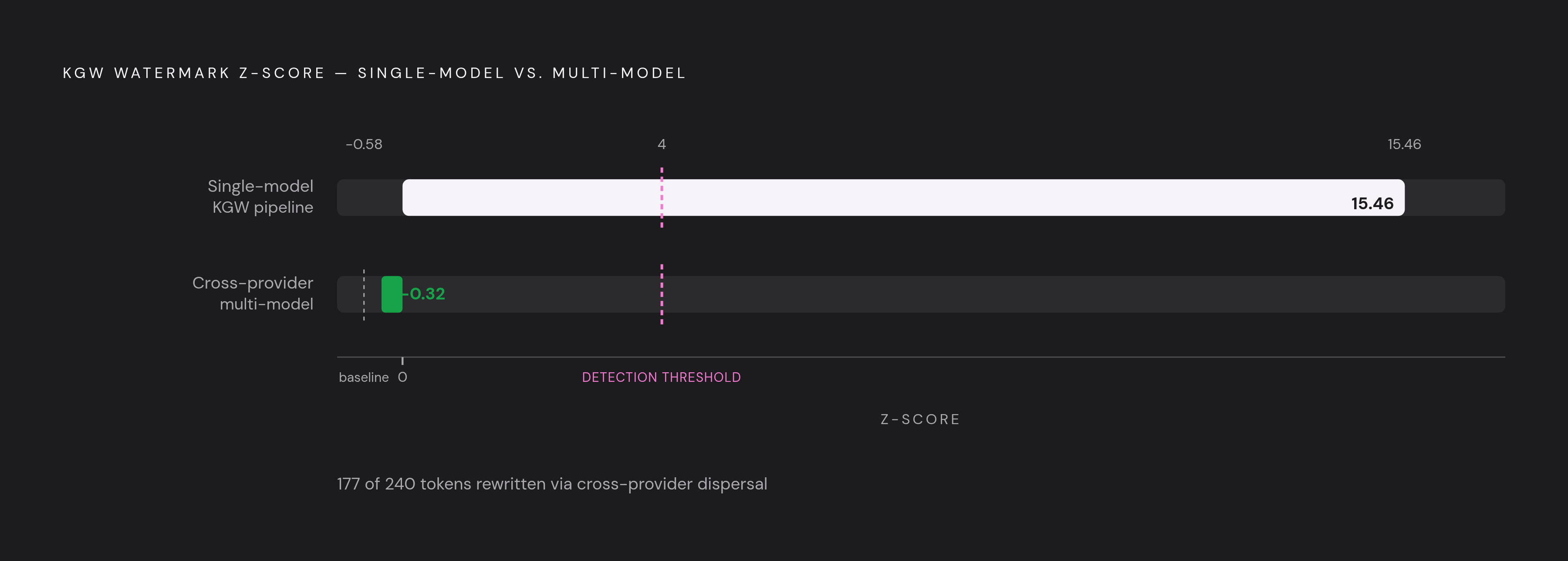
Lettershred describes an architecture in which multiple model kernels draft in parallel, a judge panel selects output line by line, and a final enhance pass unifies the voice. Its reported benchmark shows the KGW z-score falling from 15.46 to -0.32, below the detection threshold of 4. That result is consistent with the dilution mechanism. It gives a concrete measured example of cross-provider dispersal rather than relying on the presence of several model names in a workflow. Its evidentiary scope is limited to the outputs, keys, and detectors in the reported test.
Why paraphrasing and surface rewriting cannot replicate what architectural dispersal achieves
Rewriting changes which tokens appear, while dispersal changes where those tokens originate. A paraphrase pass can weaken an existing watermark by replacing choices that supported its key. If the same KGW-enabled model performs the rewrite, however, its new choices are again sampled with that model’s green-list bias. The original sequence may disappear without removing the source of fresh watermarking. This separates successful transformation of one document from a change to the generation pipeline.
A second-model paraphrase pass changes the source but can still leave the model that rewrites the text as its one dominant author. That approach is closer to a two-model workflow than same-model editing, yet it differs from structured parallel drafting and selection across providers. The distinction concerns concentration. In an architecture such as Lettershred’s, diversification is a generation-layer function. The resulting fingerprint must still be measured in the finished output.
The ICLR 2025 paper Can Watermarks Be Used to Detect Large Language Model Intellectual Property Infringement for Free? examines a deeper form of persistence. It reports LIDet accuracy above 90% when distinguishing infringing from clean models, showing that watermark signals can survive through learning from model outputs. That finding concerns model inheritance. It is therefore compatible with the forensic evaluation’s complete conditional removal result for KGW. One study addresses a signal learned through training, while the other addresses detection after a particular text transformation, and neither makes a single rewriter equivalent to dispersed authorship.
What the fingerprint profile of genuine multi-model output looks like to a detector
When multi-model output is spread across enough sources, its green-list membership under any one key can look like random variation, with no steady preference. The models that contributed may still have used their own biases. What changes is their alignment under the tested partition. A token sequence can therefore have a low whole-document KGW score even if watermarking was used to generate some of it. This is a statement about the detector’s view, with AI authorship still possible.
The z-test shows why this distinction is consequential. Its numerator is observed green count minus expected green count, so tokens that do not reinforce the tested key lower the share of tokens that count as evidence. When observed and expected counts are close, the score stays near the null. That outcome is conditional on the actual mixture. Different keys do not automatically guarantee cancellation, and a dominant contributor can preserve a detectable preference.
WaterSeeker uses anomaly extraction to find elevated watermark scores within longer mixed-source documents and is designed to work across multiple watermarking techniques. For green-token-based methods, a signal can be strong in one part of a document even when the whole-document score is low. Dispersed authorship aims to prevent those elevations from clustering under one key, but the whole-document statistic alone cannot establish their absence.
The Lettershred benchmark places its output score of -0.32 near the reported human-written baseline floor of −0.58. This gives the result more context than the threshold alone. Under that KGW test, the multi-model output does not show the pronounced green-token excess of the original. It does not follow that every detector would treat the text as human-authored.
What content teams should take from the structural difference between single- and multi-model fingerprint profiles
For content teams evaluating architectures, the relevant distinction is where diversification occurs. Same-model editing keeps one generator, while second-model paraphrasing can make the rewriter the dominant source. Cross-provider generation instead distributes contributions before the final text is assembled. Lettershred places that process behind the brief-and-outline workflow, with dispersal occurring at generation.
The evaluation criterion follows from that distinction. A multi-model claim needs evidence that the final token distribution no longer strongly reinforces the tested key. A real KGW detector gives a score that can be checked. Its score must nevertheless be read with the forensic evaluation’s false negatives and WaterSeeker’s local-detection findings in view. A below-threshold result supports a claim about that test, while reproducibility across a content program requires more than one favorable example.
The EU AI Act’s demand for reliable, robust markings does not make removal of a detectable signature proof that the obligation has been met. Architectural dispersal can explain a changed fingerprint without settling whether a particular deployment satisfies its duties. That boundary keeps the technical comparison useful.
Lettershred reports that 177 of 240 tokens were rewritten through cross-provider dispersal in the benchmark that moved the score from 15.46 to -0.32. Those figures connect the scale of the transformation to an actual detector outcome. They provide a concrete basis for evaluating its approach against same-model revision and single-rewriter paraphrasing. The standard of proof is the measured final profile under a stated test, with its limits intact, rather than a claim that rewritten text must be unmarked or that multi-model text must be compliant.