

Cross-Provider Token Dispersal as a Fingerprint Mitigation Architecture
Splitting AI text across providers weakens watermark detection without removing it.
November 2, 2026

Because KGW embeds its signal in token sampling, the strongest intervention belongs in the generation architecture. Distributing token contributions across independent providers can weaken a coherent watermark before it accumulates, although reduced detectability is neither guaranteed anonymity nor proof of regulatory compliance.
How KGW embeds a watermark at the token-sampling level
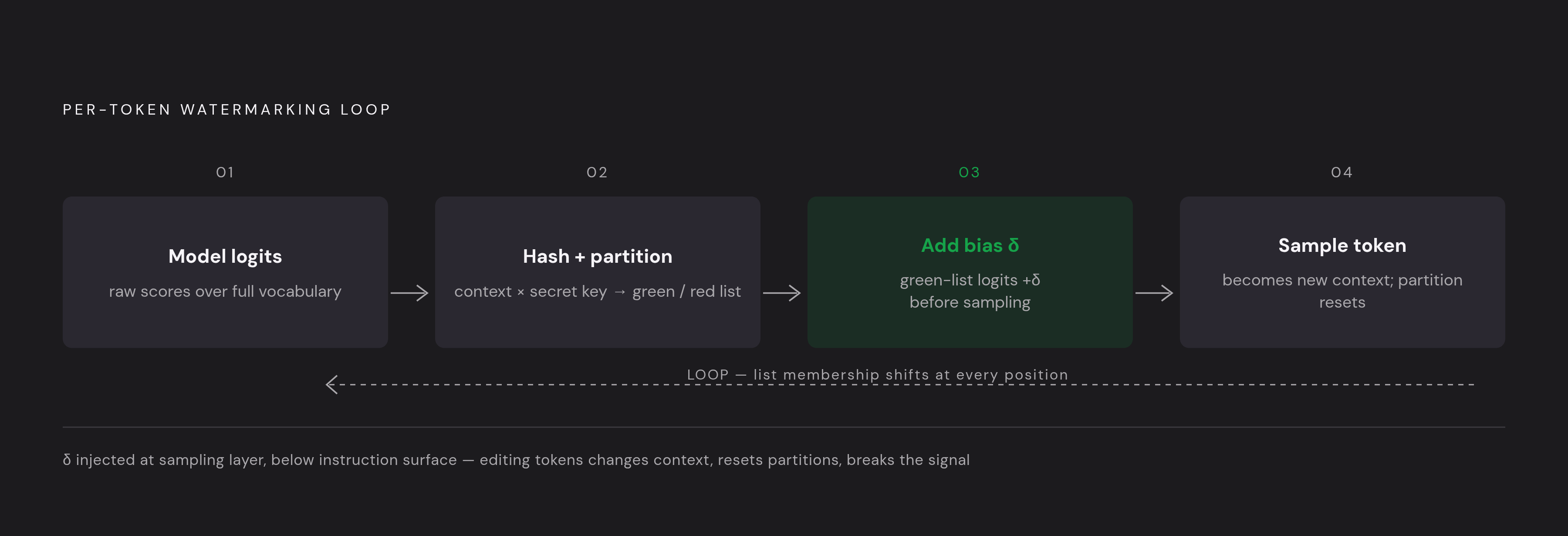
At each decoding step, a language model produces logits over its vocabulary that set how likely each token is to come next compared with the others. KGW then hashes the preceding context with a secret key to divide that vocabulary into a green list and a red list. Before sampling, it adds a fixed bias to the green-list logits, making those tokens more likely to be selected. The model need not know this is happening. The intervention sits at the sampling layer rather than in the instructions that guide the response.
The partition changes as the context changes. A token that belongs to the green list in one position may belong to the red list in another, so the watermark is not a vocabulary of preferred words that an editor could simply remove. Detection reconstructs the green list at each position using the same key and counts how often the observed token belongs to it. A one-sided z-test then checks whether that count is higher than chance would predict.
Liu et al.'s ACM survey situates KGW as the canonical keyed, logit-based green-list watermark against which later schemes are benchmarked. Its notation names the logit bias δ and the baseline green-token rate γ. For a sustained bias, the z-score grows with the square root of document length. Longer output therefore strengthens the evidence without requiring conspicuous changes in meaning.
Why the watermark is structurally immune to surface-level editing
An edit that keeps the token sequence the same also keeps the watermark evidence the same. Changing fonts, for example, does not change which tokens the model sampled. Copying the same text into a different format likewise does not undo the sampling bias. Appearance is not the detector's input of interest. Token substitutions, by contrast, can change both the observed green-token count and the context used to reconstruct it.
That distinction makes surface editing the wrong kind of intervention, but it does not make KGW immune to every rewrite. Light paraphrase may retain enough original choices to leave detectable evidence, while more extensive rewriting can disrupt it. Punctuation changes also cannot be treated categorically as harmless to the signal, because they can change the token sequence and its context.
Kirchenbauer's watermark explainer describes how greater context width, represented by h, amplifies the downstream effect of edits. A substitution can change the green-list assignments at positions whose hashing context includes the altered token. The effect depends on the context scheme. The authors recommend reducing h for greater edit robustness, which underscores that robustness is a design tradeoff. For a content pipeline, the practical weakness of editorial mitigation is its dependence on the detector and on the exact tokens that survive.
What the detection threshold actually measures and where it breaks down
The detector's null hypothesis is that green tokens occur at the base rate γ by chance. A document generated under one watermark key departs from that expectation because sampling repeatedly favors the green set associated with that key. The threshold expresses how much evidence is required before the detector makes a statistical decision to flag the text. Both a positive result and a negative result can be wrong.
Tokens generated without the tested key generally add green tokens at the null rate, while those generated under it add the excess. Interleaving those sources can therefore dilute the aggregate signal. However, dilution is not the same as cancellation. A provider that adds enough biased tokens may still leave evidence the detector can find, even when those tokens are spread across the text.
Saifur Rahman Tamim and Amir Labib Khan's “AI Watermark Evidence Fails Forensic Readiness” reports substantial KGW false negatives before any adversarial intervention. Its findings challenge the treatment of watermark detection as a reliable oracle even for unmixed output. For dispersal, the implication is narrower than a universal detection failure. The architecture must limit each key's recoverable excess relative to the amount of text the detector evaluates, rather than merely count how many providers participated. Document length, source share and the detection method remain central to that assessment.
Why paraphrase-based and query-based evasion attacks still leave structural risk
Paraphrase attacks can substantially weaken KGW, so the case for an architectural approach cannot rest on claiming that rewriting never works. Full recomposition breaks up the original sequence more than a light paraphrase that keeps many of its choices. The forensic-readiness study reports that paraphrase which kept the meaning stopped detection in the vast majority of texts that had been detected at first. That finding is consequential. It also rules out the claim that removal must always destroy meaning or quality to work.
Targeted attacks go beyond general rewriting. The Self-Information Rewrite Attack, or SIRA, identifies high-surprisal positions where watermarking may have pushed selection toward anomalous tokens and selectively rewrites them. The Bias-Inversion Rewriting Attack, or BIRA, suppresses watermarked token logits during rewriting without requiring knowledge of the underlying scheme. Both have high success rates against the schemes that were tested. Their limitation for this comparison is procedural rather than a lack of technical sophistication, because both act on output that has already been generated.
Query-based inference takes another route by using crafted prefix prompts to reconstruct parts of the green-list partition. It requires many API queries per document, making it impractical at content-team scale. These approaches all introduce a secondary intervention whose outcome depends on the original text, the rewrite or inference method, and the detector. Mild changes may leave evidence, while aggressive changes can create quality problems. Dispersal instead seeks to reduce reliance on a separate removal stage by changing how the initial document is assembled.
How cross-provider token dispersal breaks the signal by construction
Cross-provider dispersal sends different token runs through models run by different providers, each with an independent watermark key or no watermark. For a detector testing one provider's key, the other contributions dilute its excess. No knowledge of the secret keys is required. It changes the mix of sources without trying to find and replace individual green tokens.
Fine-grained mixing also targets the opportunity for span detectors, including GCD and AOL, to isolate a sufficiently long watermarked passage. That benefit depends on how the text is assembled. Routing whole paragraphs can leave long passages from one provider, while shorter contributions leave less evidence within each uninterrupted span. Nevertheless, short spans alone do not prove that every detector will fail, because aggregate evidence can remain. The architectural objective is to constrain recoverable single-key coherence.
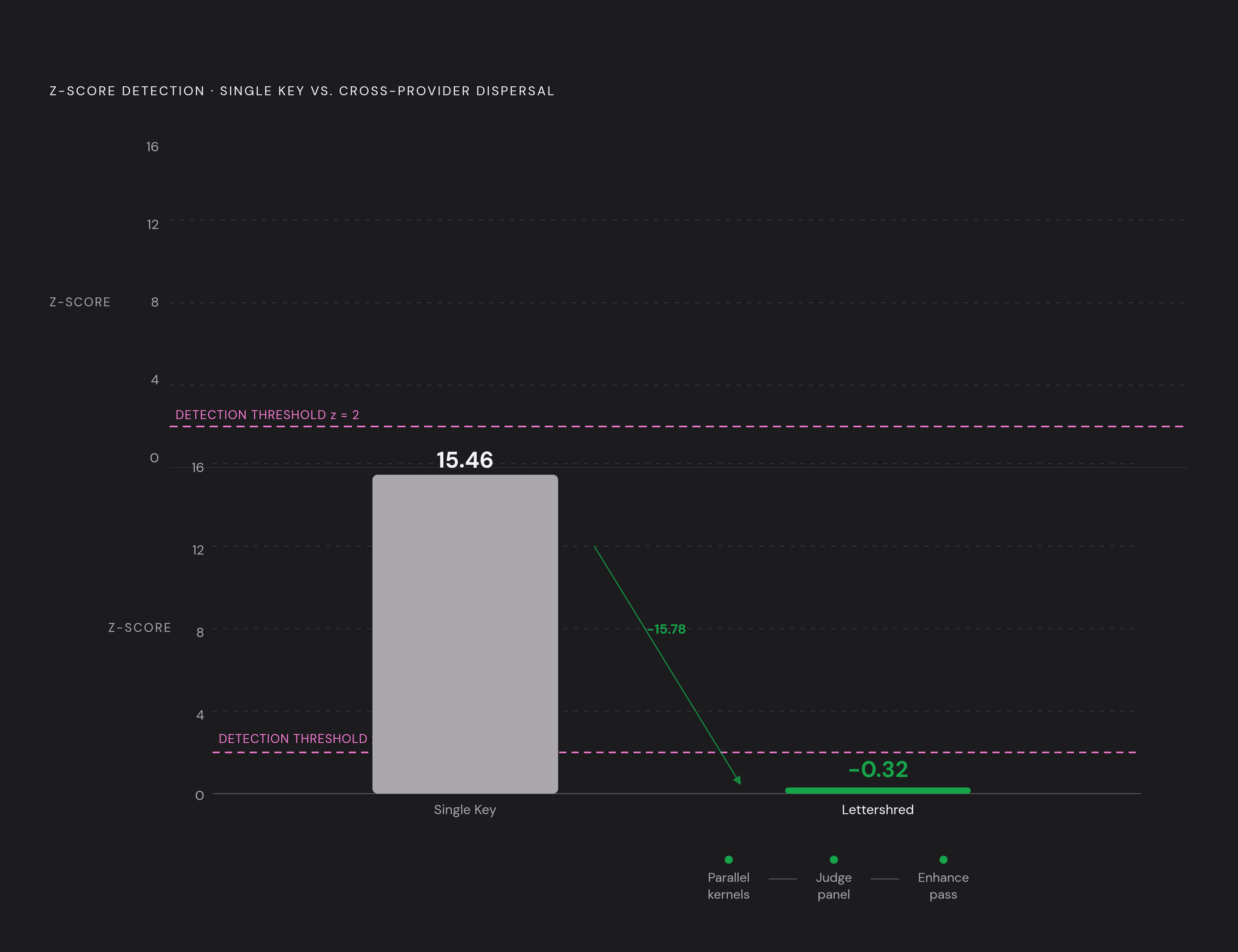
Lettershred implements this approach through parallel model kernels across providers, a judge panel that selects output line by line, and a final enhance pass that unifies voice. Lettershred reports a benchmark z-score reduction from 15.46 to -0.32 after cross-provider rewriting of most tokens, a concrete below-threshold result for the reported benchmark. The judge panel and enhance pass address the coherence problems that uncontrolled mixing can create. The assembled output still needs to be tested with all the changes made by the final pass.
What compliance frameworks require and why dispersal satisfies them structurally
The EU AI Act's Article 50 applies from August 2, 2026, and the date when California SB 942 takes effect was moved to August 2, 2026. Both require provenance disclosure for the AI-generated content they cover. Those obligations make provenance architecture commercially significant, but they do not turn detector evasion into compliance. The distinction is essential for content teams. A technical result must be evaluated separately from the duties that apply to the provider, deployer or published output.
The EU AI Act's Code of Practice sets out a layered approach involving machine-readable provenance and invisible watermarking, with fingerprinting or logging as an optional supplementary layer. C2PA alone does not provide all these layers. It records declarations made at signing time but does not check for itself whether they are true. In a multi-model pipeline, separate model-turn manifests can also make the assembled document's attribution chain harder to interpret. Dispersal therefore creates a need for clear provenance records.
The Code treats removing provenance markings on purpose as a compliance concern, while the Act has no explicit anti-stripping provision. Consequently, a pipeline designed for quality and cost cannot automatically be treated as legally equivalent to one intended to suppress a declared mark. The lack of one coherent watermark also does not exempt a pipeline from the law. Routing records, model-task assignments and classifier decisions can support an auditable account of the process, but a below-threshold z-score does not itself demonstrate compliance by construction.
What fingerprinting research reveals about the residual risk even after dispersal
“Every Model Leaves a Trace,” an October 2026 arXiv study, examines model identification through behavioral, stylometric, lexical and semantic evidence. It finds that semantic representations provide the strongest cross-lingual transfer, while highly constrained generation tasks show sharp degradation in cross-dataset fingerprint transfer. This raises a separate challenge for dispersal. Removing a detectable keyed watermark does not necessarily remove the behavioral patterns from which a model's identity can be inferred.
How well fingerprints can be recovered still depends on the task and on how similar the models are. A document assembled from several providers is a harder attribution target than a long generation dominated by one model's behavior. Its vocabulary, style or semantic tendencies need not be set by any one contributor. That risk-reduction argument concerns learned model fingerprints, which measure different evidence from watermark scores, so success against one cannot stand as proof against the other.
GhostPrint illustrates the opposite reliability problem by showing how a malicious provider can fine-tune a weaker model to mimic a stronger model's responses and bypass user-side fingerprint audits. Attribution can therefore fail through imitation as well as through mixed authorship. Fingerprinting can still be useful in both cases, but each shows the limits of relying on it as the only provenance signal. For content teams, the appropriate boundary is explicit. Dispersal can reduce the dominance of an individual model's signature, while logging and audit trails remain necessary complements rather than substitutes for anonymity that the architecture cannot guarantee.
Why the architecture is the policy: what content teams should act on
A single-model pipeline using a KGW-family watermark repeatedly exposes its output to the same keyed sampling bias. Refining a prompt does not directly remove a signal added below the instruction layer, and a separate rewriting stage adds another process to manage. Evaluate generation architecture before treating editing as the primary control. That shift need not displace the existing editorial workflow. Briefs, outline approval and brand review can stay in place while the generation layer changes.
For teams evaluating dispersal, the decision framework begins with actual cross-provider diversity. It then examines token-level selection, the length of single-provider runs, and whether voice unification preserves the intended source mixture. Quantitative tests against a real KGW detector provide evidence of watermark reduction, while provenance records support a separate compliance assessment. Both forms of evidence are needed. Lettershred's reported benchmark provides an example of the former.
The final decision should therefore distinguish three goals, namely weaker watermark detection, reduced model attribution and compliant provenance disclosure. An architecture can advance one without fully satisfying the others. Teams should assess the final output and its audit trail against each goal rather than treating a negative detector result as a universal approval. This keeps the technical claim proportionate to the evidence and the compliance claim tied to actual obligations. For reducing single-key coherence before it accumulates, the fix belongs in the architecture from the start.