

Manipulating Token Distributions to Collapse the KGW Z-Score Signal
Spreading text across several providers keeps green-list bias from building up.
November 9, 2026

KGW watermark detector evasion by z-score depends on disrupting excess green-token frequency. The analysis examines why paraphrase can erase that excess and why cross-provider dispersal targets its accumulation at the source. The architectural principle is clear, but its success still requires measurement against a real detector rather than an assumption that using several models guarantees removal.
How KGW embeds a watermark in token probabilities at generation time
Kirchenbauer et al.’s KGW construction places its watermark inside the sampling distribution. At each decoding step, it hashes the preceding context token with a secret key to produce a pseudorandom seed. That seed partitions the vocabulary into green and red sets. Green tokens receive an additive logit bonus δ, while red tokens remain unchanged. Sampling therefore favors green tokens without inserting a visible tag or special character.
The partition changes with the surrounding context. A token that is green after one predecessor may be red after another, so KGW does not maintain a fixed vocabulary of preferred words. Its watermark is a shifting preference applied during generation. This makes removal fundamentally different from deleting the zero-width characters used by earlier schemes. There is no detachable marker to strip out.
Three parameters shape the tradeoff between detectability and disruption. The green fraction γ is around one-half in standard deployment, while δ controls the strength of the sampling preference. The hashing context width h trades security against robustness to edits. Empirical comparisons of watermarked and unwatermarked DeepSeek output show that moderate δ can preserve high semantic similarity while changing surface wording. Across a passage, those unobtrusive choices accumulate into a measurable excess.
How the detector converts accumulated green-token bias into a z-score signal
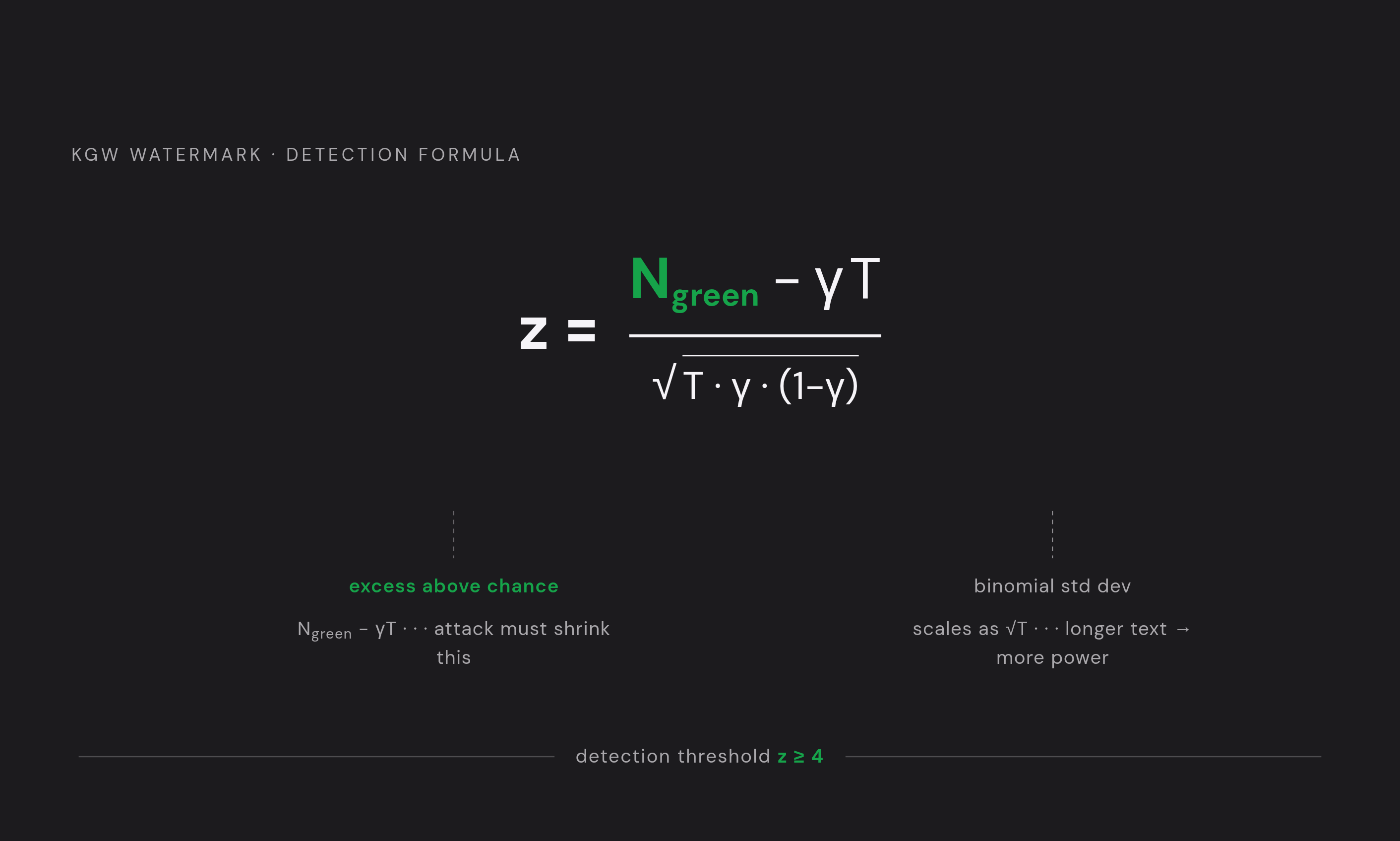
The detector reconstructs the green set at each testable position and counts the observed green tokens. It then performs a one-sided hypothesis test. Under the binomial null model, unwatermarked text has green-token probability γ, so the expected count is γT for T testable positions. The statistic is z = (N_green − γT) / √(Tγ(1−γ)), where N_green is the observed green count. A large positive value shows more green tokens than chance would explain.
This is KGW’s central statistical strength. The detector combines individually inconspicuous choices into evidence that would be difficult to identify by reading. When the green-token excess holds across a passage, the signal grows in proportion to √T, so longer passages give the detector more power. Short passages give weaker evidence even when they have a watermark.
Distributed substitutions that reduce the green count subtract from the numerator, while the denominator reflects the tested length. No individual substitution must be decisive. Enough dispersed changes can move the result below the detection threshold, producing a sharp change in classification from a gradual change in token statistics. That distinction separates manipulating the measured distribution from merely polishing the language.
Why low-entropy positions create a structural blind spot in the z-score signal
The logit bonus has limited leverage when the model already assigns nearly all probability to one token. Such low-entropy positions offer little room for substitution. Function words, punctuation, and syntactically constrained positions can fall into this category, although their role depends on context. When the preferred token stays much the same, green-list assignment adds little sampling bias. A passage with a watermark can therefore have many positions that are expected to add little signal.
The excess is concentrated where alternatives remain plausible. At these higher-entropy positions, the bonus can shift selection toward a green token that might otherwise not have been chosen. The detector still counts testable positions across the passage, but the positions producing useful excess are a smaller subset. Mixed-source documents and paraphrasing workflows can further weaken those opportunities.
Context width introduces another point of sensitivity. With a wider hashing context, one substitution can change the green-list assignments used for several subsequent tokens. Signal concentration and context dependence are structural properties of the construction. A rewriting system can change wording where the choice is uncertain without knowing the secret partition.
How paraphrase-based attacks bypass KGW watermarking by collapsing the z-score
The Bias-Inversion Rewriting Attack formalizes an approach to that concentration. The 2026 ICML paper describes using a public LLM to compute token surprisal, or self-information, over watermarked text. High-surprisal tokens become candidates for suppression during rewriting because they can reflect choices promoted by the watermark. The attack uses a statistical proxy for the positions where bias may have affected selection.
That proxy is not a direct green-token lookup. Rather, BIRA discourages selected tokens while generating plausible alternatives, changing the conditional probabilities that sustain the detector’s excess count. Its theoretical argument gives an exponential decay bound on detection probability when the average conditional probability of selecting green tokens is reduced under the analysis’s conditions. A rewrite must alter the relevant probabilities to obtain the predicted effect.
This explains why distributed rewriting can outperform isolated word swaps. A modest shift across many signal-bearing positions can cross the threshold when the original score has little margin above it. Context-dependent partitioning can compound the reduction because changed predecessors alter downstream assignments. The result still depends on the excess green-token frequency in the text that is tested.
Empirical evidence that KGW z-score collapse is total under realistic paraphrase conditions
Tamim and Khan’s forensic readiness evaluation, submitted to AIES 2026, reports total conditional removal for KGW across its valid paraphrase runs and diverse prompts. Every initially detected KGW text became undetected after meaning-preserving paraphrase. Semantic similarity remained high across those runs. The result demonstrates removal without wholesale destruction of the content. Its scope is limited to the tested conditions, however.
The evaluation also reports a 70% false-negative rate for KGW before attack. Detection was already missing much of the pristine watermarked output in that experiment. The authors classified KGW as NOT FORENSIC READY under their Forensic Readiness Score framework. That finding challenges its use as reliable forensic evidence under those conditions. It is not, by itself, a legal determination about every deployment or disclosure obligation.
The same evaluation found a high paradox rate and an uncertainty deadband containing most pristine watermarked output for the tested SynthID implementation. Switching schemes was therefore not a sufficient remedy in that comparison. Separately, the EMNLP 2025 work on watermarking identifies quality degradation from KGW at forensically useful bias strengths. Stronger embedding has a cost of its own.
Why multi-model pipelines structurally prevent green-list bias from accumulating in the first place
Cross-provider dispersal acts while the signal builds up, before any final cleanup step to remove it. A generation, editing, and tone-adjustment cascade repeatedly regenerates wording under different probability distributions. Those handoffs can interrupt the original watermark’s green-token excess. Several model names in a workflow do not establish how much of the final token sequence retains a particular watermark.
The 2025 traceability paper on role-specialized multi-agent pipelines tested GPT-4o, Claude 3.5 Sonnet, and Gemini 2.5 Pro in three-step configurations. It places accountability at the stages of the workflow through captured inputs, outputs, and deltas. This addresses a different question from watermark detection. Stage-level instrumentation documents the sequence of transformations, whereas a KGW score measures excess relative to a particular green-list construction.
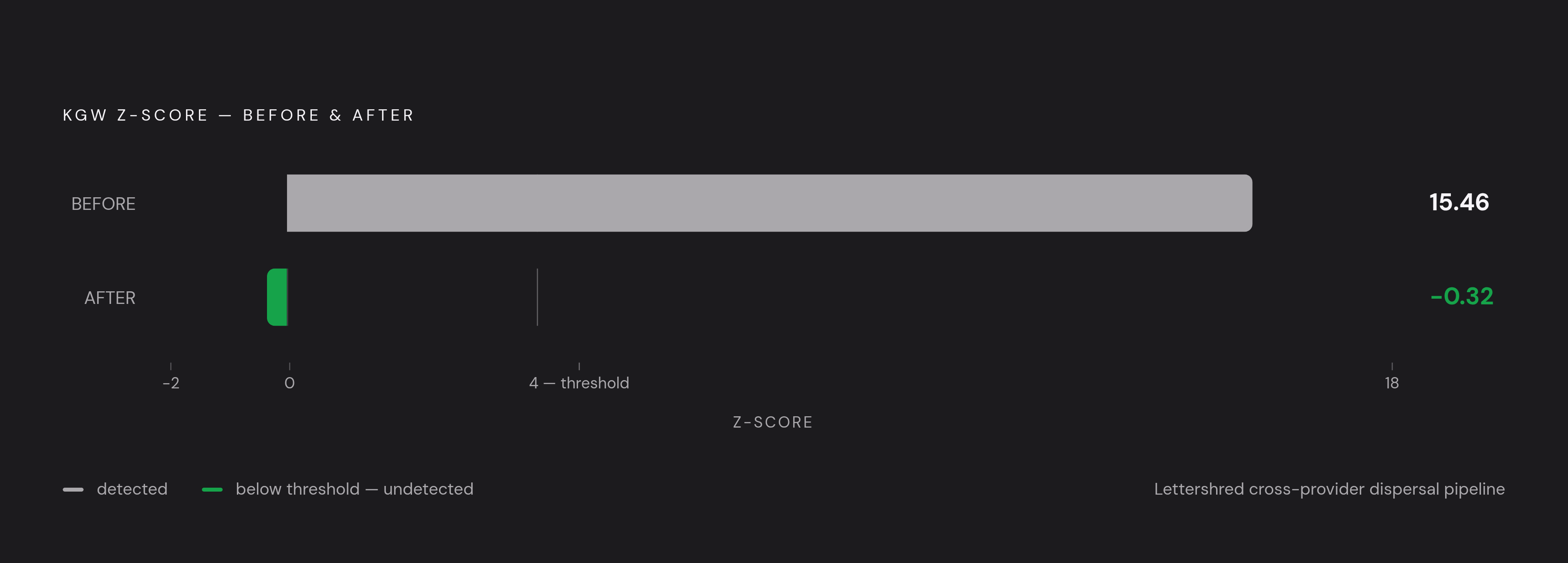
Lettershred implements dispersal through parallel model kernels, a judge panel that selects line-level output, and a final enhance pass that unifies voice. Its own benchmark against KGW reports a z-score reduction from 15.46 to -0.32 against a detection threshold of 4, with the majority of tokens rewritten through cross-provider dispersal. The company-reported benchmark is limited to the tested configuration. Independent distributions can dilute a target signal, but the final score establishes whether they did so in a particular output.
What the next generation of watermark schemes is attempting and why dispersal remains the correct response
WaterMod, presented at AAAI 2026, targets the entropy gap through probability-balanced partitioning by token rank. It distributes near-synonyms across distinct color groups to maintain a high-probability choice within the designated class at each decoding step. This changes how the watermark uses available alternatives. Topic-Based Watermarks, presented in Findings of ACL 2026, instead use semantically coherent green lists. How well they detect a watermark depends on the matching strategy, as part of a different approach to withstanding synonym substitution.
These approaches address real weaknesses in pseudorandom partitioning. They do not establish that provenance has become resistant to all rewriting or model changes. The International AI Safety Report 2026 identifies resistance to model modifications as an open problem. The evidence so far leaves open how well each successor scheme holds up. Claims about short-text detection, paraphrase resistance, and negligible quality loss require evidence for the particular scheme and conditions.
Dispersal remains a sound choice for the architecture because it changes which distributions shape the final wording. It works above the level of a particular green-list heuristic. Nevertheless, a stronger watermark could change how much transformation is needed, so durability should be evaluated. Cross-provider generation is a reason to test for reduced accumulation under each scheme.
C2PA addresses a separate layer of the problem. Its cryptographic manifests track provenance, while KGW tests for a statistical watermark associated with generation. A manifest can record a cascade of models even when no single watermark remains detectable in the resulting prose. Conversely, a low KGW score does not document that cascade or establish human authorship. Provenance tracking and watermark detection answer different questions.
What content teams need to understand about z-score compliance and how to evaluate any tool that claims to achieve it
For content teams, the practical lesson is to evaluate “mixing” or “rewriting” by measuring distributional change. A useful benchmark names the KGW detector, states the sample length, and reports before-and-after scores against an explicit threshold. Text length is particularly important because it changes detection power.
Architecture is the next criterion to examine. A team should distinguish token-level dispersal across genuinely different provider models from paraphrasing within one model’s distribution. It should also ask whether the blend preserves voice and coherence without heavy post-editing. Workflow fit completes the operational assessment. A tool that accepts existing briefs and returns a unified article addresses a different production need from one that requires the process to be rebuilt around it.
Lettershred is an option to test against those criteria. Its published benchmark supplies before-and-after scores and a stated threshold, while its judge-panel architecture selects output across provider models. The enhance pass is intended to unify voice, and the workflow accepts existing briefs and outlines. A team still needs to weigh the benchmark’s known-length requirement and whether it can reproduce the results when it judges the evidence.
Finally, “z-score compliance” must not be confused with legal compliance. A score below a detector threshold does not show that a team has met its disclosure or provenance obligations, and using multi-model generation does not by itself free the team from them. The durable architectural distinction is between controlling how statistical bias accumulates and documenting how content was produced. A defensible workflow treats both as explicit requirements rather than expecting a low detection score to stand in for accountability.