

Zero-Disruption AI Watermark Removal for Enterprise Publishing Teams
Spreading generation across models weakens KGW detection, but legal duties remain.
November 10, 2026
AI content watermark removal without disrupting an existing workflow means changing the generation step while retaining editorial review, brand checks, and publishing. Multi-model generation disperses a single model’s statistical watermark across independent providers, reducing the signal available to KGW-family detectors. The result must be tested against a specified detector, and a low detection score does not replace legal marking or disclosure obligations.
How KGW watermarks work and why the z-score is the signal that matters
KGW watermarking operates through token selection during generation. At each decoding step, a secret key and recent context divide the vocabulary into a green list and a red list. A fixed logit bias, written as δ, makes the model more likely to choose green tokens. The model can still choose red tokens. The watermark emerges because green tokens appear more often than chance would predict.
The z-score shows how far that excess is above the green-token fraction expected in unwatermarked text. A higher score is stronger evidence that the tokens follow the keyed selection pattern. Length strengthens the signal. Longer outputs give the detector more opportunities to observe the excess, which makes enterprise long-form publishing especially exposed to this form of detection. An individual word need not look unusual for the accumulated sequence to become statistically distinctive.
Increasing δ strengthens the watermark but also constrains the model’s choices, creating a tension between detection and output quality. Large biases are therefore impractical for services that need fluent, useful text. The signal also has a narrower meaning than an authorship verdict. It shows that a model was involved, so text written by a human and passed through AI editing or polishing can gain the same kind of watermark as text generated entirely by AI.
Why paraphrasing removes the watermark statistically but does not solve the problem
Paraphrasing disrupts KGW detection by replacing the tokens on which the score depends. Because the green/red partition changes with context, substitutions alter both the selected tokens and the partitions used for later selections. The original green-token excess can disappear. The z-score then falls below the detector’s threshold even when the rewritten text preserves the original meaning.
That statistical success does not make paraphrasing a reliable publishing architecture. Stronger evasion can come at the expense of output quality, while targeted rewriting requires information about likely green tokens. SIRA identifies potential green-list candidates without prior knowledge of the watermark algorithm or key, widening the attack surface. But it remains an attack on an existing output. A 2025 arXiv paper also argues that successful watermark removal can leave another detectable signal in images, illustrating why defeating a watermark verifier and achieving forensic stealth are different outcomes.
For a publishing team, the practical objection is straightforward. Why not add a paraphrase step after every draft? That step must either identify likely green tokens or substitute blindly, and its reliability must be reconsidered when the model or watermark configuration changes. It also adds another transformation where quality can deteriorate. The structural alternative is to address the signal during generation rather than apply a fresh repair to each finished output.
What the EU AI Act's Article 50 actually requires of enterprise publishing teams
The EU AI Act’s Article 50 separates machine-readable marking from human-visible disclosure. Providers of generative AI systems must mark synthetic output in a machine-readable format. Some deployers also have a separate duty to disclose AI-generated content, including deepfakes and AI-generated text published to inform the public on matters of public interest. These are distinct duties with different responsible parties. Treating them as a single labeling requirement obscures what an enterprise must establish about its role.
The European Commission’s FAQ states that Article 50 applies from 2 August 2026, with the existing-system grace period running to 2 December 2026 for the Article 50(2) machine-readable marking obligation only. The interoperability deadline is 2 February 2027. That timetable makes provenance an operational concern. A low KGW score does not show that either duty has been met, and required marking or disclosure is still needed when a watermark is removed.
Provenance also serves purposes beyond regulatory labeling. It helps show who is responsible, helps enforce an organization’s rules about approved models, and helps address the risk that too much machine-generated training data will harm model quality. AI editing is not automatically free of provenance concerns simply because a human wrote the initial draft. Outside enterprise compliance, academic conferences including NeurIPS 2026, book publishing, and literary prizes have taken steps to spot AI-generated submissions because of concerns about integrity and how common these submissions have become.
Why detection risk falls unevenly on enterprise content teams — and why false positives are a liability
Detection burdens differ across publishing workflows because teams use AI assistance differently. Non-native speakers may need more help with writing, so teams that work across the world are especially likely to leave signals that a model was involved. A grammar pass and full generation are not equivalent editorial acts. Yet a watermark alone cannot express that distinction, leaving teams to reconcile a statistical finding with the actual history of a document.
False positives compound that problem. AI Watermark Evidence Fails Forensic Readiness found that a SynthID configuration flagged 5.4% of paraphrased human-written controls as AI-generated. That result belongs to the tested configuration, not every SynthID deployment. It nevertheless demonstrates a direct publishing liability, since human-authored material can receive an incorrect AI attribution. Detection is therefore evidence to interpret when assessing authorship.
The reverse problem appears in multi-stage AI workflows. Drafting, editing, translation, and formatting may pass through different models, whose watermarks can overwrite or corrupt one another. A marker inserted at drafting may consequently become unreliable downstream, even when model involvement is undisputed. Labeling everything as AI-assisted leaves this technical weakness in place because visible disclosure and machine-readable provenance are still separate duties.
The single-model fingerprint: why any pipeline built on one provider is structurally exposed
A pipeline repeatedly using one watermarked model recreates the conditions for detection with every draft. The green/red partition is deterministic given the secret key and context, so generation repeatedly favors the same keyed mechanism even though individual partitions change. Longer text accumulates evidence of that bias. Rewriting one article may erase its detectable excess, but it does not change how the next article will be generated.
Watermarking deliberately embeds a signal, while fingerprinting infers provenance from inherent model idiosyncrasies without requiring an embedded mark. Avoiding watermarked models therefore does not eliminate every route to attribution. Provenance can be bound to content at creation or inferred afterward through similarity-based analysis. A successful KGW test result addresses only the first mechanism.
The ICLR 2025 LIDet paper demonstrates that student models can inherit detectable watermarks through knowledge distillation, with detection persisting after fine-tuning. Apparent diversity can also be misleading. Two API endpoints from one provider may share green-list logic, so the number of endpoints alone cannot show that generation is independent.
The diagnostic shift is from the document to the pipeline. Post-hoc editing changes tokens that have already been chosen through a biased selection process. An architectural response instead changes which independent processes contribute those tokens.
Why dispersing generation across multiple independent models breaks the statistical signal by construction
Multi-model dispersal draws text from independent providers so that one keyed process does not dominate generation. Under the mechanism described here, a token favored by one provider’s green list is statistically random with respect to another provider’s partition. Mixing those contributions can reduce the excess observed by a detector testing one key. The target is a particular statistical signal. It is not universal immunity from AI detection or provenance inference.
This approach depends on genuine independence and sufficient dispersal. Mixing parallel drafts at the token level spreads their tokens across incompatible key spaces, which brings the observed green-token fraction closer to the detector’s null expectation. Multiple calls to the same underlying model do not establish that condition. Nor does the architectural principle alone prove that every model mix, output length, or selection process will fall below a detection threshold.
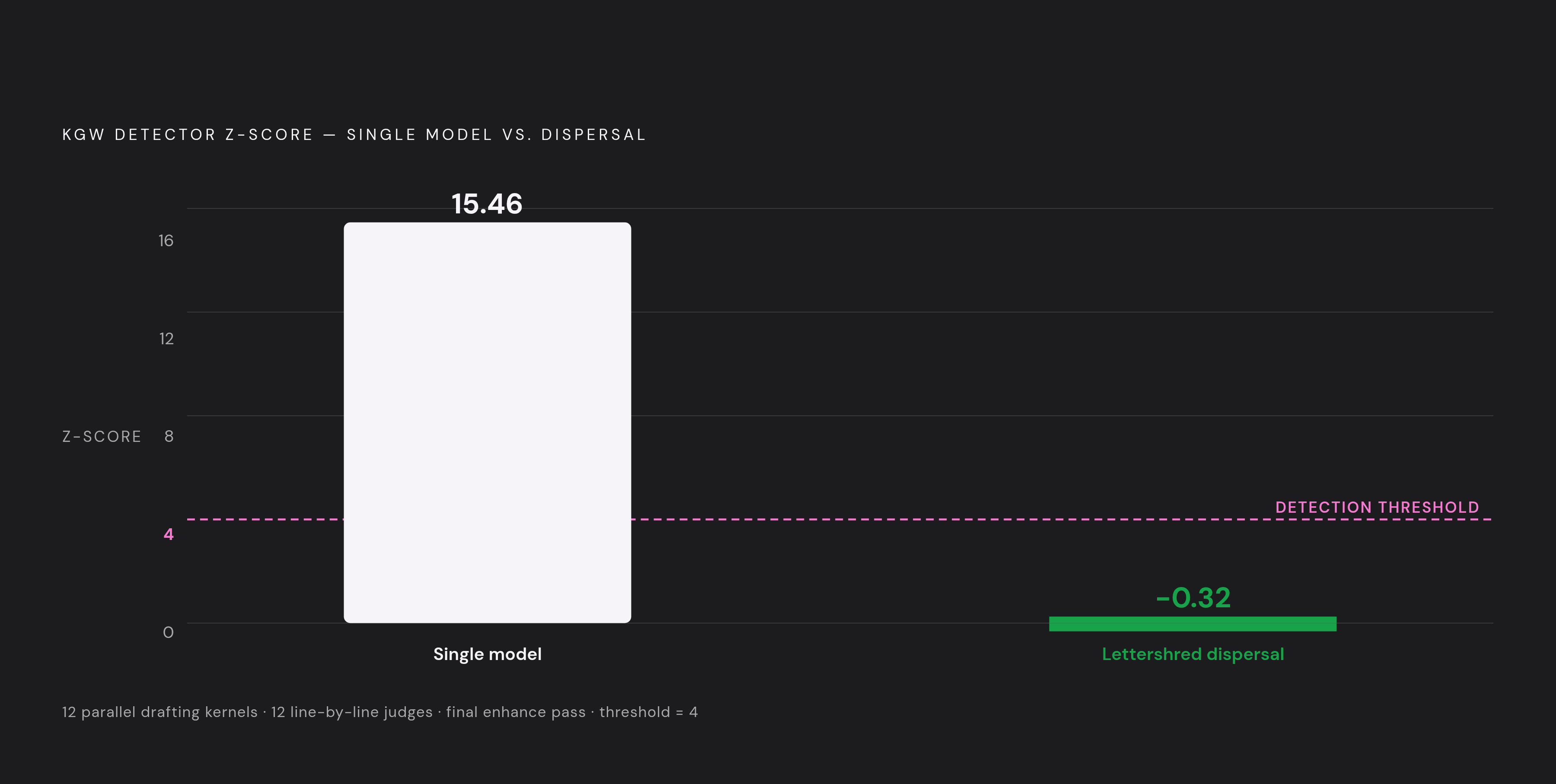
Lettershred, a tool that blends AI models to reduce watermark detection, reports a KGW-detector result moving from a z-score of 15.46 to -0.32, below a threshold of 4. Its architecture uses a dozen kernels drafting in parallel, a dozen judges voting line by line, and a final enhance pass. It reports rewriting the majority of tokens through cross-provider dispersal. Those results apply to the tested configuration only.
The ACL 2025 MorphMark paper establishes the tension between fixed-strength watermark effectiveness and text quality. Dispersal takes a different route. Rather than lowering δ within one model, it combines outputs governed by incompatible signals, although the aggregate still needs testing.
How do teams remove AI watermarks without changing their publishing process?
The operational proposal is to replace the generation component while retaining the brief-in, draft-out interface. The brief, outline, and house style still go in, and one draft still goes to reviewers. Editorial approval, editing, brand compliance, and publishing stay where they are in the steps that follow. That is the scope of “zero disruption.” It describes continuity in the content process, with provenance obligations still applying and individual integrations potentially requiring changes.
Writer places style-guide checks, terminology validation, and word-choice rules in a brand-enforcement layer over generation output. Jasper’s Brand Voice profiles likewise illustrate persistent stylistic constraints at the output layer. These functions do not inherently require a single authoring model.
In Copy.ai’s documented agency example, the time it took to create a campaign fell from multiple days to one day. As an operational illustration, it shows why brief quality, approvals, and throughput belong in the workflow discussion. The model producing a draft is only one component of that process.
For an architecture such as Lettershred’s, line-by-line judging and a final enhance pass address the obvious coherence objection to mixing models. The intended output is a unified voice. Its design principle is to keep the existing content process and change generation alone.
What to verify before trusting any watermark removal claim
A credible claim identifies the detector, reports before-and-after z-scores, and accounts for token-level changes. Buyers should also establish how many independent providers contributed and whether the test was repeated against a different watermark configuration. Configuration details define the claim’s scope. Without the detector, text length, and model mix, a score cannot show how well the method works beyond the reported example.
Anthropic’s Claude watermarking rollout in August 2026 prompted removal tools within days, including an open-source project, but the absence of a public detector prevents independent verification of their text-watermark claims. Google’s SynthID Detector became public in October 2026 for images, video, and audio. Its text-watermarking variant is a separate system. A vendor that names SynthID therefore still needs to say which system it tested.
The Lettershred benchmark illustrates the useful distinction between a reported result and a general guarantee. Its KGW-family score comparison, stated threshold, and account of majority-token rewriting make the claim more concrete than an assertion that output is “undetectable.” But those details do not show that the tool works against every configuration or that cross-configuration testing took place.
The Tsinghua watermark robustness paper demonstrates removal through targeted paraphrasing and inference-time neutralization when watermark rules are known. Those methods require acquiring the rules first, limiting what their results establish for unknown configurations. Architectural dispersal operates independently of that knowledge and still requires detector-specific evidence for its output.
Sources
- Published as a conference paper at ICLR 2025 CAN WATERMARKS BE USED
- Can LLM Watermarks Robustly Prevent Unauthorized Knowledge Distillation?
- AI Watermark Evidence Fails Forensic Readiness: An Empirical Evaluation
- MorphMark: Flexible Adaptive Watermarking for Large ...
- MorphMark: Flexible Adaptive Watermarking for Large Language Models
- Removing the Watermark Is Not Enough: Forensic Stealth in Generative-AI Watermark Removal
- Lettershred · Keep the process, remove the watermark