

What AI Fingerprint Removal Actually Costs Your Editorial Team in Time and Process Overhead
Editing out AI watermarks costs hours in repeated rewrites and checks.
November 18, 2026
Removing AI watermarks without disrupting an editorial workflow means changing generation rather than adding repeated editing and detection passes. Manual rewriting can reduce a watermark, but its full cost includes editing time, verification, rework, and review records. Multi-model generation can change how the text is built, if it uses independent providers and detector-specific benchmarks back the claim.
How KGW watermarks work and why they are structurally hard to escape by editing alone
KGW watermarks are statistical patterns. The ICLR 2025 paper on watermark-based IP detection describes a process in which a hash of the previous token divides the vocabulary into a green list and a red list. The green list contains tokens given a higher chance of being selected at that step. A constant bias, δ, is added to their logits, which are the scores used to determine sampling probabilities. The model can still select other tokens, but its choices favour the green list across the sequence.
A detector counts green-list tokens and calculates a z-score, which expresses how far the count departs from what would be expected without watermarking. If the score exceeds a preset threshold, the detector classifies the text as watermarked. A larger δ strengthens detection but can reduce text quality, while a weaker bias makes the signal less conspicuous.
Replacing a familiar phrase does not address all the token choices that contributed to the score. Newer approaches, including SynthID-Text, Unigram, grammatically guided watermarking, and Stateless Bernoulli watermarking, broaden the detection surface through different partitioning and sampling methods. Their differences complicate any universal editing prescription.
Why paraphrasing and synonym substitution fail as a reliable removal strategy despite appearing to work
Manual editing improves clarity, corrects tone, and repairs structure. Paraphrasing can also defeat a detected watermark, so dismissing it as wholly ineffective would be inaccurate. The Tsinghua/CUHK paper, Can LLM Watermarks Robustly Prevent Unauthorized Knowledge Distillation?, examines both targeted and untargeted paraphrasing for removing inherited watermarks. Its findings support the possibility of removal across multiple schemes and settings. They do not make ordinary rewriting a predictable production method.
The distinction is knowledge of the watermark rules. Targeted paraphrasing is a specialised intervention that integrates the inverse of extracted rules into a paraphrase model such as Dipper. Untargeted paraphrasing uses no such rule knowledge, and the same paper finds that it does not consistently reduce detection significance to non-watermarked levels across all settings. Standard editorial rewriting falls into this less predictable category.
The prose may read better, but the team still needs a detector to check whether the z-score fell below the relevant threshold. If it did not, another rewrite and another check follow. The hidden cost starts with that need to verify every apparent success.
The actual editorial hours that accumulate when fingerprint removal is treated as a review task
An editor asked to “humanise” a draft receives two different assignments. One is to get the facts right, match the voice, and put the article in order. The other concerns a statistical result that cannot be established by reading alone. Combining those assignments obscures where the time goes. A polished article can pass the first test and still fail the second.
The operational cost is the additional work attached to that failure. Generation leads to review, paraphrasing, re-detection, and revision, with another cycle whenever the acceptance test remains unmet. At dozens or hundreds of articles per month, those checks become part of the regular workload, even if they were once rare. The hours editors spend depend on how many passes they make and how long each takes, so one estimate for every article would hide what teams need to track. Time spent on fingerprint remediation belongs separately from time spent improving the article.
The EU AI Act service desk text of Article 50(4) describes an exemption that involves human review or editorial control and taking editorial responsibility for what is published. It does not prescribe logs of reviewer identities, timestamps, or individual changes. When an institution’s policy calls for a record of the review chain, each further attempt at remediation adds records that the team must keep. That overhead is real when the requirement applies, but it should not be presented as a specific logging mandate imposed by the Act.
How prompt-tuning and single-model variation create a false sense of evasion
A request for different phrasing changes which tokens are plausible, while KGW green-list biasing remains a function of the decoding process, hash key, and vocabulary partition. Changes to temperature likewise do not show that the watermark logic is independent. The resulting draft may look substantially different. That visible difference is not evidence that its statistical signature has disappeared.
Two API endpoints from the same provider may share green-list logic, so switching between them may leave the same watermark architecture in place. The Invisible Entropy paper illustrates a related limit through entropy-aware watermarking, which selectively marks high-entropy tokens while leaving predictable positions alone. Selective application can still leave a detectable signal. Changing the prompt does not, by itself, remove that possibility.
A team can spend time refining prompts, accept the new draft as resolved, and discover a detection failure only after later editorial work has finished. Returning to generation then puts that later work at risk of repetition. Prompt variation remains a writing technique, but its success at producing different prose cannot stand in for a detector result. Treating those outcomes as interchangeable postpones verification until rework is more disruptive.
What process complexity looks like when multiple removal tactics are layered on top of each other
A draft begins with one model, passes through manual paraphrasing, and returns to a detector. If it still fails, prompt-tuning produces another draft, which then needs voice review and any required review record. All of these steps may leave in place the generation mechanism that caused the original signal.
The sequence becomes generate, detect, paraphrase, re-detect, re-edit, and log. Those stages also interact. A paraphrase can move the text away from the brand standard, while regeneration can replace passages that an editor already approved. The final voice review consequently absorbs variation introduced by earlier remediation. This is not an argument against voice review, but an account of why its workload grows when upstream interventions keep changing the text.
Detection research already considers combinations of interventions. The EMNLP 2025 paper on grammatically guided watermarking evaluates schemes across eight attack types, so layering tactics is not evidence that a pipeline’s output will evade detection. A failure after editorial approval can send the article back to an earlier stage and invalidate later work. When review logging is required, the record must also include those changes. Going back to earlier stages adds to the work as well as adding more stages, so counting editing passes alone leaves out some of the cost.
Why the structural cause — single-model provenance — is what actually needs to change
For a KGW-watermarked draft, the shared weakness of these tactics is their starting point. They start with the sequence one model has generated and then try to fix its statistical properties. The detector, however, evaluates the accumulated green-list preference across that sequence. Individual sentences are only parts of the measurement. Improving them does not necessarily remove the document-level signal.
The ICLR paper reports that watermark signatures can persist after fine-tuning on watermarked data. That finding shows the regularity can survive beyond the original generation event, although it does not establish that every manual rewrite will fail. An editorial team cannot assume that a surface intervention will erase a signal robust enough to persist through other transformations. Its process still needs evidence of the resulting score.
An architectural alternative changes which sources contribute to the generated text. Dispersing token-level decisions across models with independent green-list partitions is intended to prevent one partition’s bias from accumulating throughout the document. Independence is the operative condition, which multiple endpoints sharing the same watermark logic do not establish. The design shifts intervention from additional review at the editing stage to diversity at generation, assessed through detector results.
How can multi-model generation remove AI watermarks without changing the publishing workflow?
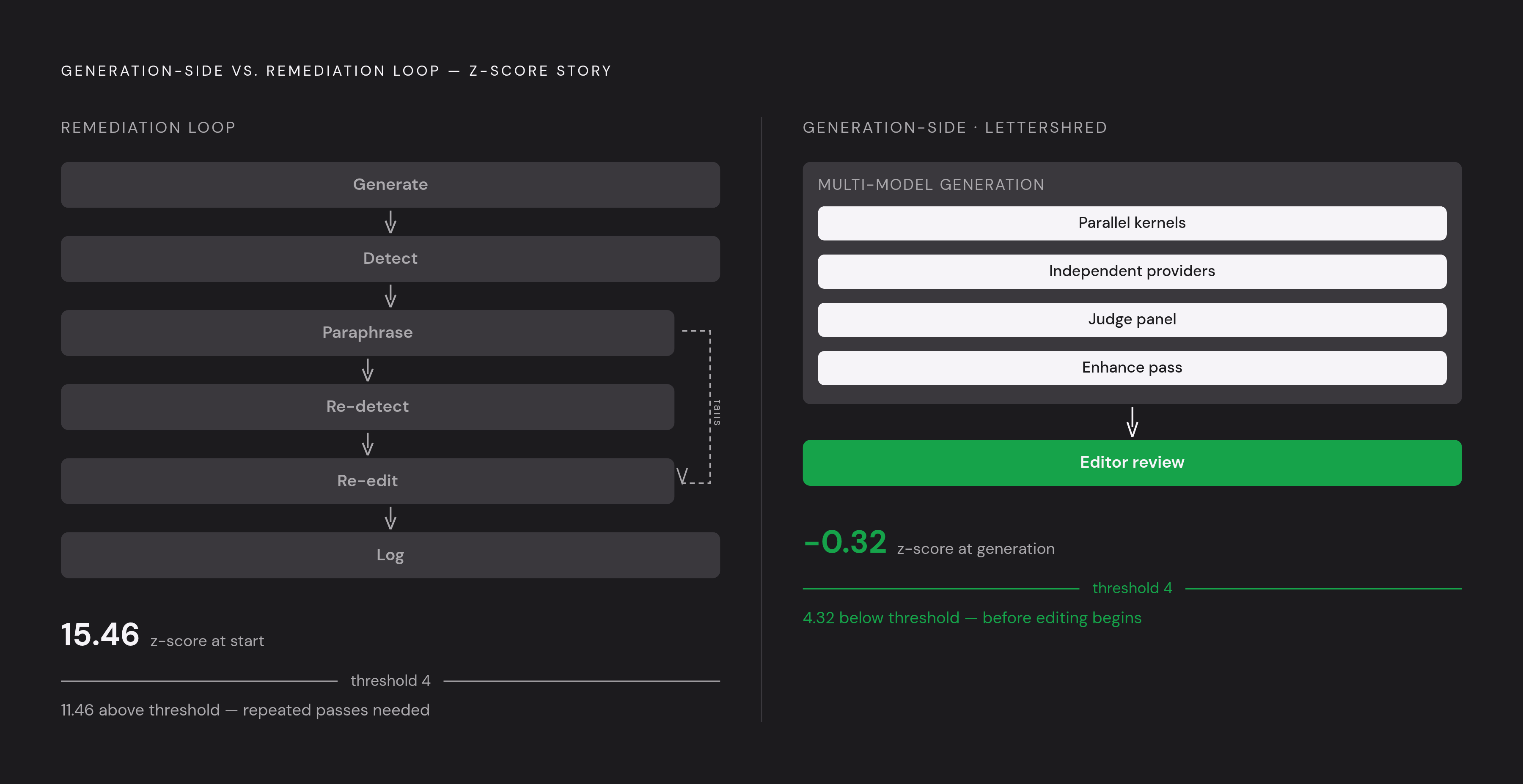
Lettershred, from The Letter Company, applies this approach within the generation step. A dozen kernels draft in parallel across different models, a judge panel selects output line by line, and an enhance pass unifies the result into one voice. The intended replacement is the single-model drafting stage, while brief preparation, outline approval, and brand review remain in place. Its use of independent providers addresses the shared-partition problem that nominal model variation leaves unresolved.
Lettershred reports a z-score change from 15.46 to -0.32 against a KGW detector, below the detection threshold of 4, at high cross-provider dispersed coverage. The benchmark involves rewriting the majority of tokens through that dispersal. It backs the reported result under those conditions, but it gives no guarantee against every watermark scheme. A result achieved during generation can remove the need for another pass to remove the watermark, while editors still have their usual responsibilities.
Other multi-model configurations warrant the same scrutiny applied to Lettershred’s benchmark. The evaluation questions are whether providers are genuinely independent, which detector was used, what the before-and-after z-scores were, and whether the output still needed removal afterward. These criteria distinguish an architectural change from another post-processing stage.
The Tsinghua/CUHK paper also finds that inference-time watermark neutralization can remove inherited watermarks while preserving knowledge. That supports generation-time intervention as a research direction, but does not independently validate every cross-provider implementation. The practical comparison remains specific. Post-processing adds a remedial loop, while a successful generation-side approach delivers its measured result before the editor begins work.
What content teams should audit in their current pipeline before choosing a path forward
Does one model from one provider draft the article, or do independent providers contribute during generation? If several endpoints are involved, does their use establish independent green-list logic, or only different settings? Model count alone does not answer it.
The next question concerns work after the first draft. How many times is the article touched because of detection risk rather than quality, and which later tasks must be repeated when a detector flags it? If a check follows editing, the process needs a defined response to failure. Otherwise, an unresolved loop remains inside the publishing schedule. When review records are required, the same audit should check whether they are made automatically or someone has to do more work to create them.
Tool evaluation then follows from the pipeline diagnosis. Which detector was tested, what were the z-scores before and after, and how many tokens were rewritten across how many independent providers? A claim without a named detector or before-and-after scores leaves its central result unverifiable. The final distinction is whether removal remains a separate task after generation or whether the generation method already achieves the required detector result. The teams that spend the least time on fingerprint removal are those that make it unnecessary at the generation step.
Sources
- Flip, Don't Shuffle: Watermarking LLMs at the Speed of Inference
- Invisible Entropy: Towards Safe and Efficient Low-Entropy LLM Watermarking
- Published as a conference paper at ICLR 2025 CAN WATERMARKS BE USED
- Can LLM Watermarks Robustly Prevent Unauthorized Knowledge Distillation?
- Watermarking with Low-Entropy POS-Guided Token ...
- Lettershred · Keep the process, remove the watermark